Real movement for virtual training.
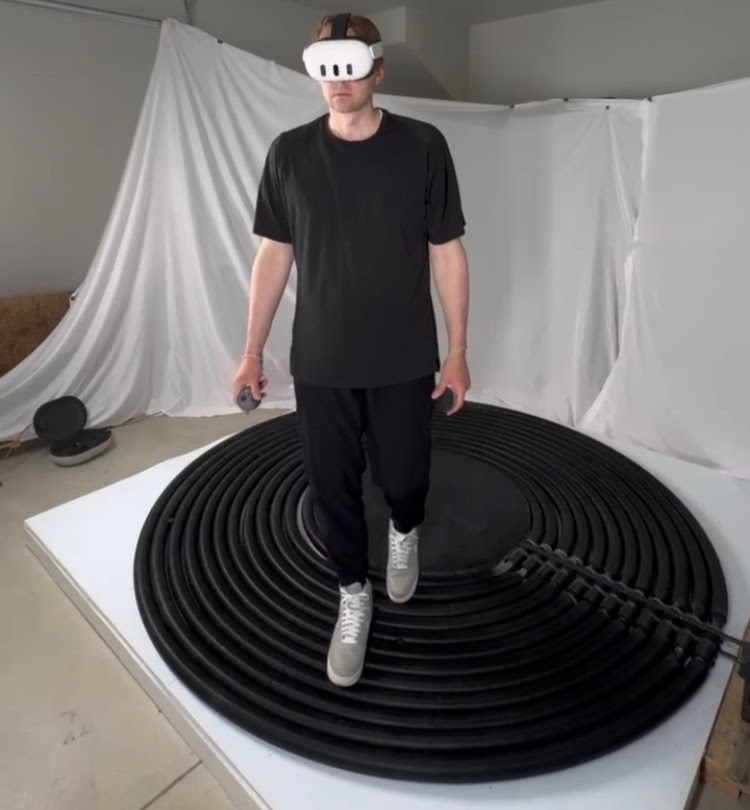
OmniTrek is developing a harness-free omnidirectional treadmill that lets users physically walk, turn, and move inside VR environments.
VR visuals have advanced quickly, but movement is still often handled through joysticks, teleportation, or limited room-scale tracking. OmniTrek is being built to make physical movement part of the simulation itself.
- Proof-of-concept prototype
- Harness-free design goal
- 360-degree locomotion
- Built for training and simulation
The Problem
VR training is improving. Physical movement is still behind.
Modern VR can create convincing visual environments, but movement often breaks the experience. Joystick locomotion, teleportation, small room-scale spaces, and harnessed platforms do not fully replicate how people move through real environments. That matters when the goal is training, decision-making, spatial awareness, and physical performance.
Limited movement
Room-scale VR works until the scenario requires distance, turning, repeated movement, or complex navigation.
Artificial locomotion
Joysticks and teleportation can reduce realism and change how users behave inside the simulation.
Training gap
For defense, public safety, and high-consequence training, movement is part of the task, not just a controller input.
The Solution
A compact omnidirectional treadmill designed for natural VR locomotion.
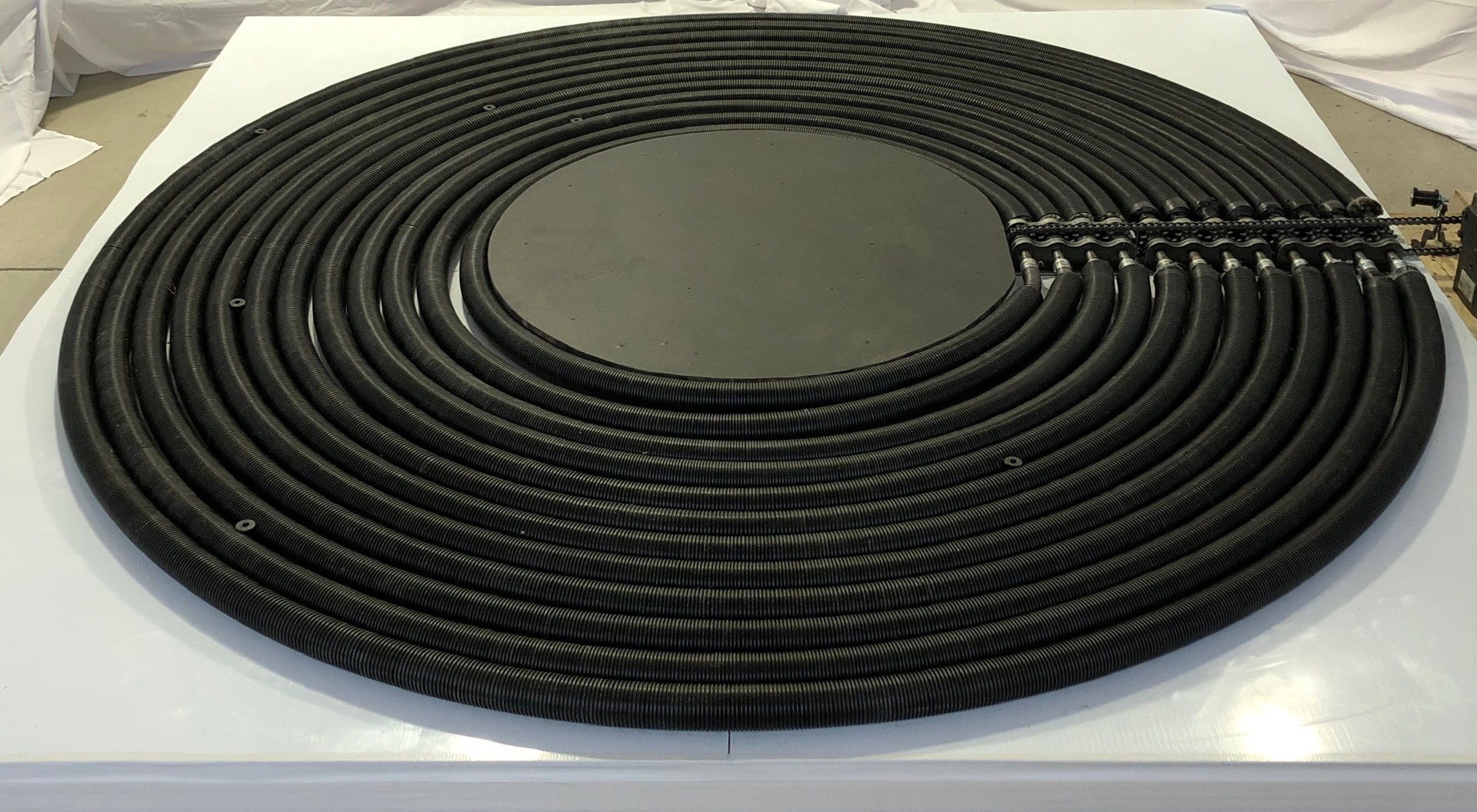
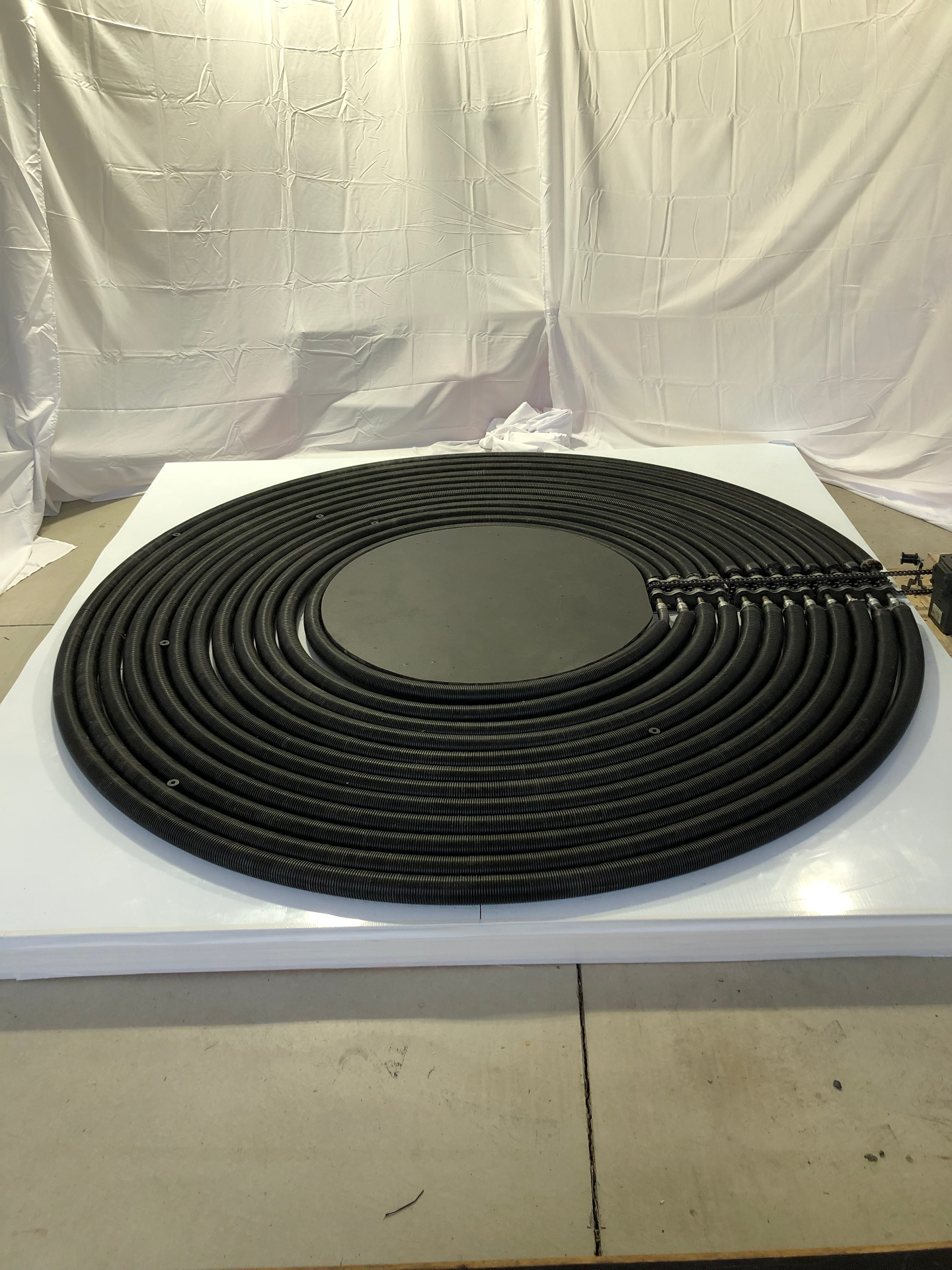
OmniTrek uses a roller-based surface and controlled motion to support walking, turning, and directional movement without requiring a harness or special footwear. The current prototype is focused on proving the mechanical architecture and control approach before moving into a more refined MVP.
Omnidirectional movement
Users are intended to move in any direction while staying centered on the platform.
Harness-free design goal
The system is being developed to avoid bulky waist rings or overhead support systems.
Roller-based surface
The prototype uses a concentric roller layout to support directional movement.
Compact circular footprint
The circular architecture is designed around a more practical training and simulation footprint.
VR training integration
OmniTrek is being built with simulation, training, and headset-based environments in mind.
Path to pilot testing
The next phase is focused on engineering refinement, controls, safety, durability, and partner evaluation.
Demo
See the prototype in motion.
This demo shows the current proof-of-concept direction for OmniTrek. The system is still in development, with the next major goal being a more refined MVP suitable for pilot testing and partner evaluation.
Interested in evaluating OmniTrek for training or simulation?
Start a ConversationUse Cases
Built for training environments where movement matters.
OmniTrek is initially focused on use cases where physical movement, spatial awareness, and repeatable training scenarios are important.
Defense training
Dismounted movement, patrol scenarios, room clearing, situational awareness, and mission rehearsal all depend on how people physically move through space.
Public safety and first responder training
Fire, rescue, law enforcement, and emergency response simulations can benefit from movement that feels closer to real-world navigation.
Enterprise simulation
Industrial safety, equipment training, and spatial process training can become more realistic when users physically move instead of clicking through a scenario.
Longer-term consumer applications
Beyond training, the platform may eventually extend to VR fitness, location-based entertainment, and consumer VR.
Featured
National Defense Magazine · July 2026
Virtual Reality Treadmill Simulates Military Training Scenarios
A recent feature covering OmniTrek's proof-of-concept platform, its defense use cases, and the path from concept toward pilot-ready systems.
Prototype
From proof of concept to pilot-ready platform.
The current OmniTrek prototype has been used to validate the core concept: a circular locomotion platform designed around concentric compliant roller paths. The system is still early, but the working prototype helps demonstrate the physical scale, user interaction, and basic movement approach.
- 01
Current stage
Proof-of-concept prototype
- 02
Next step
MVP engineering, control refinement, safety review, and durability improvements
- 03
Pilot testing
Partner-led evaluation with training and simulation organizations
- 04
Longer term
Application-specific versions for training, simulation, and other markets
OmniTrek is currently seeking strategic partners, pilot customers, and funding support to move from proof of concept toward a pilot-ready system.
Engineering
Engineering a better way to move in VR.
OmniTrek is being developed from a mechanical-first perspective. The goal is to solve the physical movement problem in VR with a platform that can support natural movement patterns, repeated training scenarios, and practical integration into simulation environments.
Mechanical architecture
Refining the roller layout, structure, durability, and user interaction.
Controls and centering
Improving how the platform responds to movement and keeps the user positioned during VR activity.
Safety and usability
Developing a system that can be tested with real users and evaluated by training partners.
What's Different
What makes OmniTrek different.
A real physical platform
OmniTrek is not just software locomotion. It is a physical movement platform designed to let the user move naturally inside virtual environments.
Designed around natural movement
The system is being developed to support walking, turning, and directional movement in a compact footprint without requiring a waist ring, harness, or special footwear.
Mechanical-first team
OmniTrek is being built by people who treat this as a mechanical engineering problem first, with the goal of repeatable, evaluable training scenarios.
The product is currently in development. Final specifications, safety limits, system dimensions, and pricing will be determined during MVP engineering and pilot testing.
Founder

Bennett Mortensen
Founder, OmniTrek Inc.
Bennett Mortensen is a mechanical engineer and technology commercialization professional focused on moving early-stage technologies from concept toward market. OmniTrek grew out of a long-running effort to solve one of VR's most persistent problems: how to let people physically move through virtual environments in a more natural way.
Connect on LinkedInContact
Interested in OmniTrek?
OmniTrek is looking for conversations with defense training groups, VR simulation companies, pilot partners, investors, and organizations interested in the future of physical movement in VR.
Reach out directly — we read every message.
FAQ
Frequently asked questions
Is OmniTrek available for purchase?
Not yet. OmniTrek is currently in development and moving from proof of concept toward a more refined MVP.
Who is OmniTrek built for?
The initial focus is training and simulation, especially defense, public safety, and enterprise use cases where natural movement matters. Longer-term applications may include gaming, fitness, arcades, and consumer VR.
Does OmniTrek require a harness?
The design goal is harness-free movement. The current prototype is being used to validate the mechanical and control approach.
Can OmniTrek integrate with existing VR platforms?
The long-term goal is compatibility with training and simulation environments, but final integration details will be determined during MVP development.
What type of partners are you looking for?
OmniTrek is looking for pilot partners, training organizations, simulation companies, defense stakeholders, investors, and technical collaborators.
How is OmniTrek different from other omnidirectional treadmills?
Other systems exist in this space, often relying on low-friction surfaces, special footwear, or waist harnesses. OmniTrek is being developed around a harness-free, roller-based approach. The prototype is early, and direct comparisons will be more meaningful once the MVP is built and evaluated.